Most job seekers spend hours polishing their CV, then throw together a cover letter in two minutes — or skip it entirely. The result is an incomplete application competing against candidates who presented a full picture of themselves.
Here is what most people miss: your CV tells a recruiter what you have done; your cover letter tells them why they should pick you specifically. In an Arab job market where dozens of applications chase a single opening, that difference is often enough to tip the decision.
This guide walks you through how to write a cover letter step by step, with a ready structure, three complete templates for different situations, and the mistakes that get applications rejected on sight.
What Is a Cover Letter?
A cover letter is a short, one-page message attached to your CV when applying for a job. Its job is to connect three dots:
- Who you are and why you want this particular role.
- What you bring in terms of skills and results that serve the company's needs.
- Why this company rather than any other.
It is not a prose version of your CV. Your CV is a list of facts; your cover letter is a short, persuasive story. If your CV isn't ready yet, start with our guide on how to write a professional CV — the letter is built on top of it, not instead of it.
Do Cover Letters Still Matter in 2026?
Yes, for a very practical reason: most candidates either don't write one or write a bad one. That alone turns a strong letter into a free competitive advantage.
Beyond that:
- Competitive roles (admin, marketing, sales, customer service, office positions) usually favour the candidate who communicates most clearly.
- Career changes and CV gaps cannot be explained inside a CV. The cover letter is their natural home.
- Small and medium companies are often screened by the hiring manager directly — the person most influenced by a carefully written letter.
When can you skip it? Only if the job ad explicitly says not to include one, or the application system offers no field for it. Otherwise, always attach it.
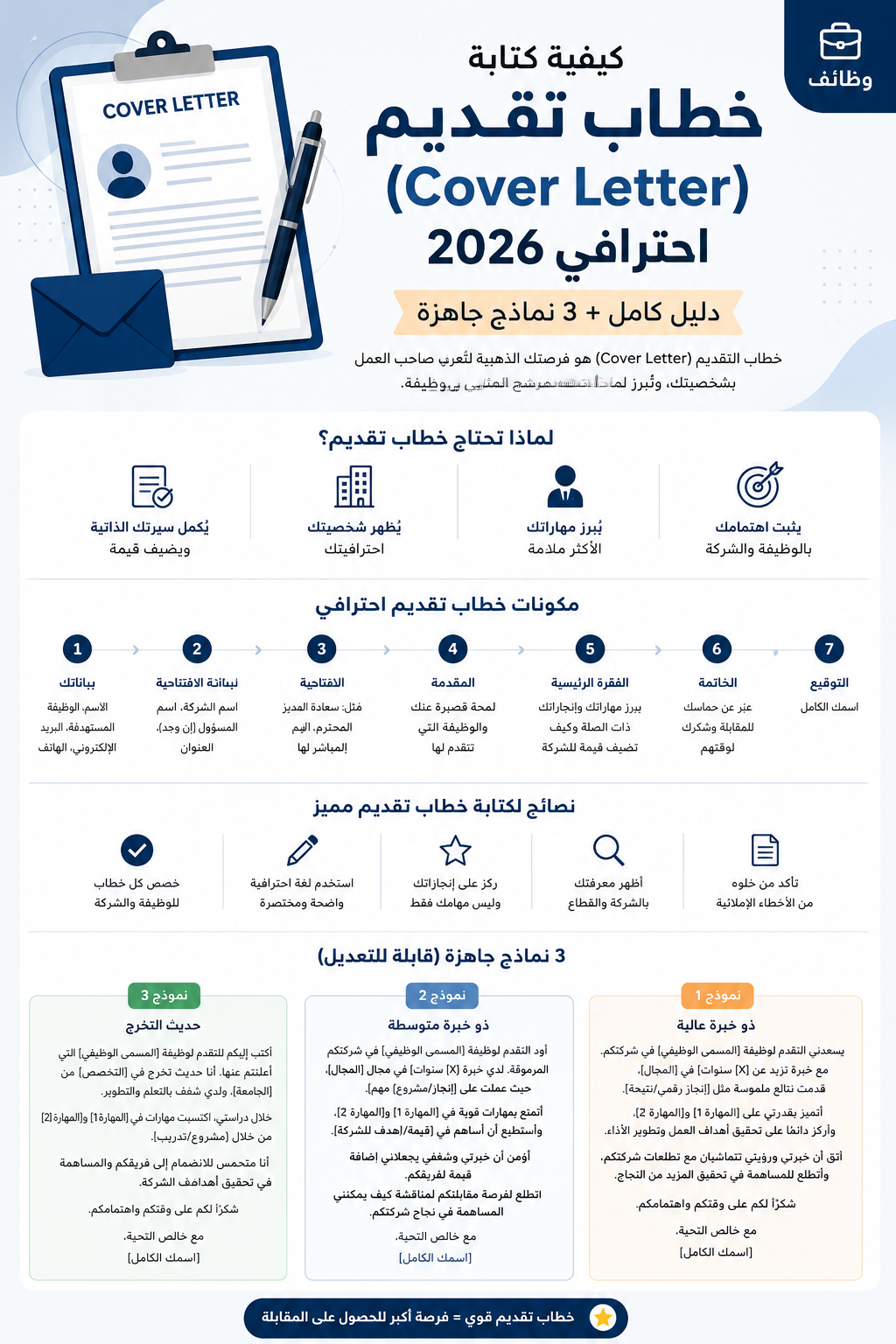
The 6-Part Structure of a Strong Cover Letter
An effective letter runs 250 to 400 words and has six clear parts.
1) Header
Your full name, phone number, email, city, and LinkedIn URL. Use the same header formatting as your CV so both documents look like one coherent package.
2) Salutation
Use a name whenever possible: "Dear Mr. Ahmed Al-Shammari." Check the company's LinkedIn page for the hiring manager.
If you cannot find one, use "Dear Hiring Manager" or "Dear [Company] Recruitment Team."
⚠️ Avoid entirely: "To Whom It May Concern." It reads cold and signals a mass-sent letter.
3) Opening Paragraph — The Hook
The worst possible opening: "I am writing to apply for the position advertised on..." A recruiter reads that sentence thirty times a day.
Lead with your strongest card instead:
"Over the past two years, I raised the e-commerce conversion rate at [X] from 1.2% to 3.4%. When I read that [Company] is expanding its digital sales, I knew this was the role I wanted."
Golden rule: the first two lines decide whether the rest gets read at all.
4) Middle Paragraph — The Proof
This is where you prove you solve the company's problem. The most reliable method: read the job ad, pull out the 2–3 core requirements, and match each one to a real achievement.
| What the ad asks for | How you answer it |
|---|---|
| "Experience managing ad campaigns" | "Managed a 40,000 SAR monthly ad budget at a 4.2x return" |
| "Strong communication skills" | "Delivered weekly presentations to a 12-person team and prepared management reports" |
| "Fluent English" | "Worked daily in English with suppliers in Turkey and China" |
Use numbers wherever you honestly can. A number gets believed; an adjective gets forgotten.
To see what employers are actually screening for this year, review our guide to the most in-demand skills in the job market and pick the ones that genuinely apply to you.
5) The "Why This Company" Paragraph
Two or three sentences showing you researched the company and did not send a generic letter:
"I followed your launch of 24-hour delivery in Riyadh, and I believe my experience running last-mile operations could support extending the service to Jeddah and Dammam."
This paragraph alone separates you from 90% of applicants.
6) Closing and Call to Action
Close with confidence, not pleading:
"I would welcome the chance to discuss how my experience can serve your team's goals. I am available for an interview at your convenience. Thank you for your time and consideration."
Then: "Sincerely, [Your Name]."
⚠️ Do not write: "I hope you will accept my application" or "I would be honoured if you considered me." Pleading language weakens your position before negotiation even starts.
Do ATS Systems Read Cover Letters?
Yes, many of them do. So:
- Save as a PDF with a clear filename:
Ahmed-Ali-Cover-Letter.pdf - Use a standard font at 11–12pt
- Avoid tables, images, and columns inside the letter
- Weave the job ad's keywords naturally into your text
The same rules that govern an ATS-friendly CV apply here. You can save time and build an ATS-compliant resume ready to submit immediately.
3 Ready-to-Use Cover Letter Templates
Template 1: Fresh Graduate, No Experience
Dear [Company] Recruitment Team,
In my final year of business school, I led a team of five students on a capstone project that turned a startup's real sales data into an analytics dashboard, helping cut dead stock by 18%. That project taught me that good analysis starts with understanding the problem, not the tool.
I am applying for your Junior Data Analyst role because I work confidently in advanced Excel, SQL, and Power BI, and completed three certified data analysis courses over the past year. My practical experience is limited, but my learning speed and reliability are why I was invited back for a second summer internship at [Organization].
What draws me to [Company] is your focus on data-driven decisions — precisely the field where I want to build my career.
I would be glad to discuss how I can support your team. Thank you for your time.
Sincerely, [Name]
💡 If you are just starting out, also read our guide on how to get a job without experience.
Template 2: Experienced Professional Seeking a Step Up
Dear Mr. [Name],
Across six years in supply chain management, I reduced annual shipping costs at [X] by 780,000 SAR through supplier renegotiation and redesigned distribution routes.
Your advertisement notes you are seeking an operations manager who can lead a multi-site team and control operating costs. I managed 22 employees across three warehouses and raised inventory accuracy from 91% to 99.3% in eight months using a simple cycle-count system.
What makes me specifically interested in [Company] is your recent Gulf market expansion — a stage whose operational challenges I know first-hand.
I would be glad to share my initial thinking on the first 90 days in the role. Thank you for your consideration.
Sincerely, [Name]
Template 3: Career Change
Dear Hiring Manager,
I spent five years teaching, and the last two of them building digital content and running an educational platform that reached 40,000 followers. Today I am applying for your Content Marketing Specialist role.
The move may look like a leap, but the core of both professions is the same: understand the audience, simplify the idea, measure the impact. I grew platform engagement by 60% in six months by analysing what the audience actually read, then rebuilding the editorial calendar around it.
Over the past year I completed two certified courses in SEO and content marketing, and I run a personal blog drawing 8,000 monthly visits from organic search.
I am confident my teaching background would give your content a voice that explains rather than merely sells. I would welcome the chance to discuss it.
Sincerely, [Name]
7 Mistakes That Cost You the Job Instantly
- One letter sent to every company. It is spotted in seconds and kills the application.
- Repeating your CV in prose. It adds nothing new.
- Talking only about yourself. "I want to develop my experience" — the company wants to know what you will deliver to them.
- Spelling errors. One misspelled company name is enough.
- Excessive length. Going past one page means it will not be read.
- Exaggeration. Anything inflated will surface in the interview.
- Forgetting the attachment. Check your files before hitting send.
Frequently Asked Questions
What is the ideal cover letter length? 250 to 400 words, one page maximum — three to four paragraphs.
Should I write it in Arabic or English? Match the language of the job ad. If the ad is in English or the company is multinational, write in English.
Should I paste it in the email body or attach it? Best practice: attach it as a PDF and include a 3–4 line summary in the email body itself.
What's the difference between a cover letter and a CV? A CV is an objective record of your experience and qualifications. A cover letter is a persuasive message tailored to one specific role.
Can I write it with AI? Yes, as a starting point — provided you review it and add your real numbers and details. You can generate a professional cover letter in a minute and then personalise it yourself.
Conclusion
Knowing how to write a cover letter is less a writing skill than a listening skill: read the job ad closely, understand what the company needs, then prove — with numbers — that you are the person who meets that need.
Tailor a letter to every role, keep it short, and open with your strongest achievement.
When you're ready, browse the latest available jobs on Wazaayf.com, and prepare with our guide to common interview questions and answers to complete your journey to a job offer.